
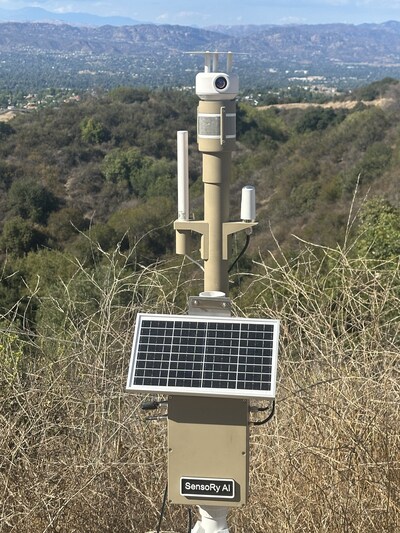
His startup SensoRy AI says its sensors pick up the invisible signs a fire gives off in its first minutes, and they are already deployed with the Orange County Fire Authority.
Ryan Honary was traveling with his father when the TV in their hotel room cut to news of a wildfire burning in an area that looked very similar to his family’s home in Southern California. His mother had stayed behind.
He called her in a panic. She was safe. What came next surprised him.
“I felt a wave of relief,” he says. “But then I felt guilt for feeling relief.” On the screen, other families were losing everything.
The question that followed him home was simple. Why does a fire get that big before anyone knows it exists?
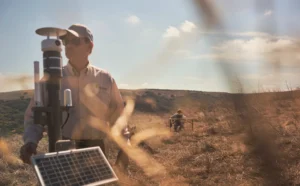
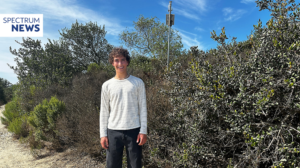
Years later, he built what he believes is an answer. Honary, who graduated from high school in Newport Beach, California, this spring, is the founder of SensoRy AI, a startup with a patented sensor network for what the city of Irvine calls ultra-early wildfire detection: catching fires in their first minutes, before flames or smoke can be seen. His sensors are already in the ground with the Orange County Fire Authority and the City of Irvine, and Honary says the company also has deployments in Laguna Beach and in communities around the Santa Monica Mountains. And in April, the company says, one of their sensors detected a real fire before anyone reported it.
Most wildfire detection still depends on eyes. A driver spots smoke and calls 911, or a lookout camera catches a plume on a ridgeline. By then a wind-driven fire may already be growing exponentially, and every minute of head start matters. The Palisades and Eaton fires that swept Los Angeles County in January 2025 showed how fast a wind-driven fire can outrun detection.
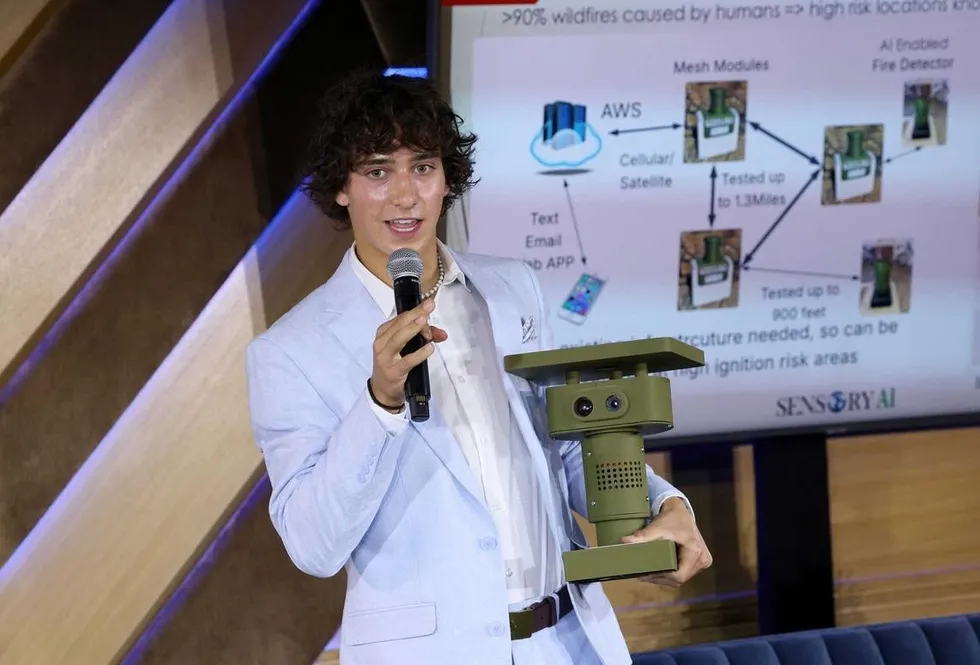
Honary’s system is meant to start earlier. The moment a fire ignites, he says, his sensors are designed to pick it up even without a direct line of sight, and to flag the location to fire professionals.
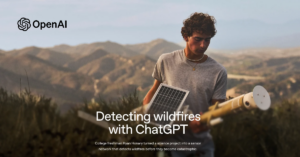
He got there by combining the things he loved: engineering, physics, computer vision and artificial intelligence. His first prototype ran on a Raspberry Pi, a small hobbyist computer, with the AI doing its work on the device itself so an alert would not have to wait on a faraway server. That design became his first U.S. patent, issued in July 2025, for running a machine learning model across a network of low-power devices. He was still in high school.
The harder part was getting anyone to listen.
The project began in 2020 as a science fair entry, and for a while that is how the world treated it. Fire is a field run by veterans, and a teenager with a Raspberry Pi did not look like the future of it.
The science fairs changed that. Honary started winning national awards, the awards drew media coverage, and the coverage reached Orange County Fire Authority Chief Brian Fennessy. Honary presented his idea to fire scientists at UC San Diego, and that ultimately developed into a working partnership with the Orange County Fire Authority. In February 2025, OCFA and the city of Irvine installed test sensors in the Irvine Open Space Preserve. ‘Early detection is one of our greatest weapons,’ Fennessy said of the effort.
“Their belief in me taught me that passion, humility and persistence can open doors that age alone cannot,” Honary says.
The results kept coming. At the 2025 International Science and Engineering Fair, the world’s largest pre-college science competition, Honary took second place in embedded systems along with special awards from the Office of Naval Research and Qorvo. He was lead author on research presented at an IEEE conference and on a review of early wildfire detection technologies published in the ASME Open Journal of Engineering, which became the journal’s most accessed article of 2025. Homeland Security Today named him one of its Top 50 Trailblazers. In January, his team reached the final five of XPRIZE Wildfire, a global competition judged on field tests with real fires.
The pilot with the Orange County Fire Authority and the city of Irvine began in February 2025, with sensors placed where ignitions are most likely to start. According to the city, the test units performed even better than anticipated. Then came a moment Honary had been building toward since that hotel room. In April, according to the company, a SensoRy AI sensor in Calabasas, California, picked up an actual wildfire from more than a mile away, before anyone had called it in.
Now the pilot is becoming a network. On July 27, the city of Irvine announced plans for a large-scale deployment of the sensors across its Open Space Preserve beginning in early 2027, funded through the California Department of Conservation’s Regional Forest and Fire Capacity grant program and designed to complement the state’s wildfire cameras by filling gaps they cannot see. Irvine Mayor Larry Agran said protecting the city’s open spaces also protects the neighborhoods that border them, calling the network ‘a promising use of technology to strengthen public safety.’ SensoRy AI and the Irvine Ranch Conservancy hope the project grows into a network covering the coastal open spaces of central Orange County, including areas around Laguna Beach, Newport Beach and Crystal Cove State Park.
This fall, Honary heads to Stanford University as a Wildfire Fellow, and he plans to stay directly involved in the company. He believes the same sensing approach can eventually stretch to other environmental threats.
He is also trying to shorten the road for whoever comes next. Through Climate Solutions Society, a nonprofit he founded, Honary hands other students the basics of his original Raspberry Pi design, sample code and sensors included. The group has grown to six chapters, and several teens have started environmental projects of their own.
Ask what he hopes people take from all of it and he does not lead with the patent or the prizes.
“If my journey encourages even one student to pursue an ambitious idea that makes the world a little safer or better,” he says, “I would consider that one of my greatest accomplishments.”
He was a kid who felt helpless in front of a hotel TV. Now the thing he built stands watch in the hills, and this spring, by the city of Irvine’s own account, it reported an ignition before any person or camera did. To keep up with his work, follow Honary on Instagram and LinkedIn.